Account Risk Triage Board For POD Sellers
account risk triage board for POD sellers is a high-intent topic because the reader is already trying to fix risk reduction before…
POD evergreen market research is a high-intent topic because the reader is already trying to fix niche validation before design production. This page turns that intent into a practical Octozia workflow for POD marketplaces sellers.
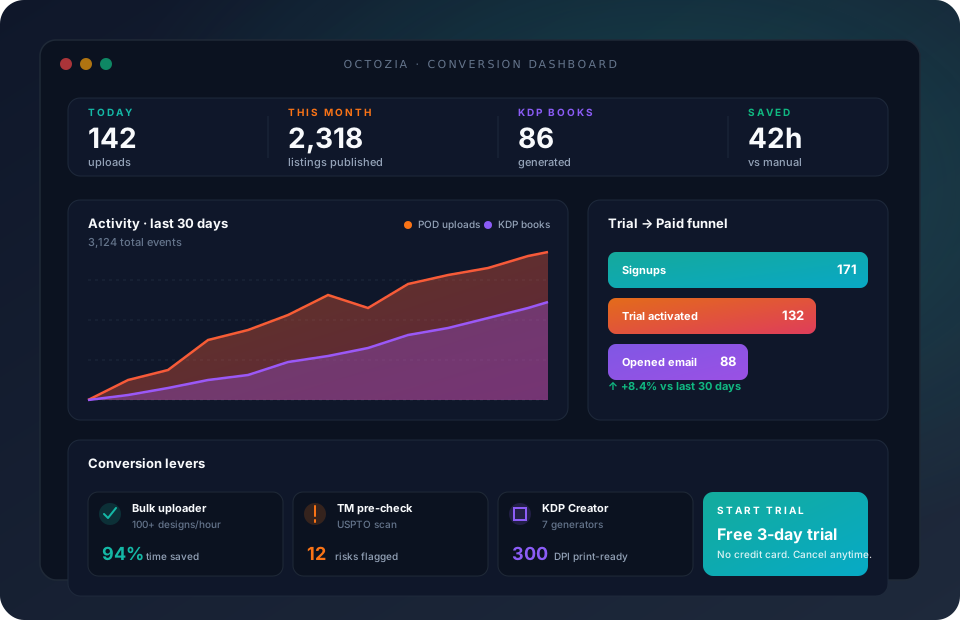
The useful angle for POD evergreen market research is not a definition. It is the moment when POD marketplaces sellers realize that crowded markets is costing time, quality, or account safety. Octozia should appear as the workflow that organizes the next step. Page focus: POD evergreen market research; first test: test a narrow buyer angle.
For this page, the reader's pain is practical: they need niche validation before design production, but they do not want another disconnected checklist. Tie the copy to Niche Research Tool, then show how the seller can move from phrase list to faster batch review without rebuilding the process every session. Page focus: POD evergreen market research; first test: test a narrow buyer angle.
The conversion goal is a small commitment. Ask the reader to try test a narrow buyer angle, then measure whether Octozia gives them faster batch review. This is a better path than asking a cold visitor to trust a broad claim. Page focus: POD evergreen market research; first test: test a narrow buyer angle.
This topic belongs close to the product because the reader can imagine the first session quickly. A page about POD evergreen market research should move from problem, to example, to Niche Research Tool, to a trial button without wandering into generic POD advice. Page focus: POD evergreen market research; first test: test a narrow buyer angle.
score ideas before production using competition, trend recency, tag occurrence, and profitability signals. The article should make the tool feel operational, especially for sellers who are already dealing with print-on-demand listing workflows. Page focus: POD evergreen market research; first test: test a narrow buyer angle.
Avoid padding this page with repeated definitions. The copy needs distinct sections for the buyer problem, the Octozia workflow, the quality check, and the trial path. That structure makes POD evergreen market research feel useful instead of duplicated. Page focus: POD evergreen market research; first test: test a narrow buyer angle.
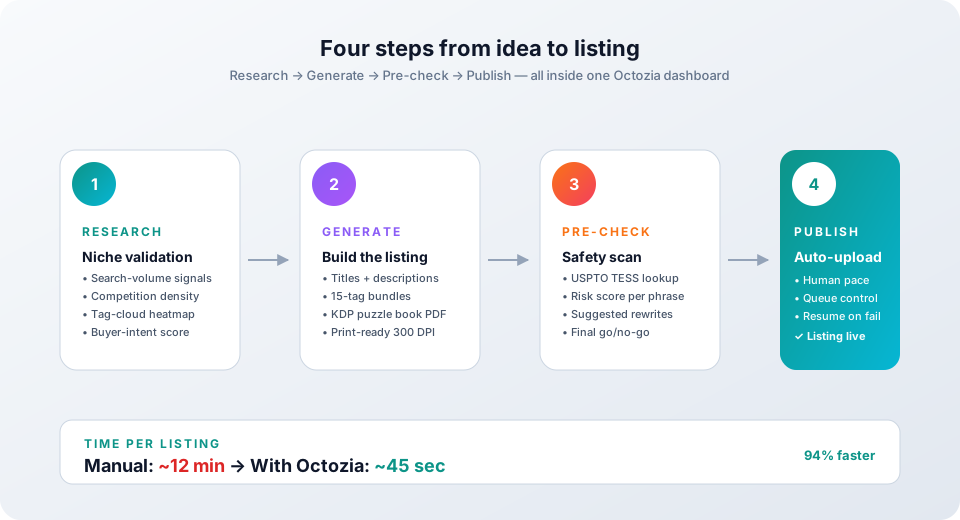
Niche Research Tool fits because POD evergreen market research is already asking for a system. The article should map the reader's current mess to the part of Octozia that removes the most friction. Page focus: POD evergreen market research; first test: test a narrow buyer angle.
A seller does not subscribe for a menu of features. They subscribe when the product removes a repeat problem. Connect Niche Research Tool to faster batch review, then keep the CTA close to that proof. Page focus: POD evergreen market research; first test: test a narrow buyer angle.
Keep the CTA practical: try the workflow, compare the time, and decide from a real POD marketplaces batch. Page focus: POD evergreen market research; first test: test a narrow buyer angle.
Check whether the phrase has visible buyer intent and products that shoppers actually buy. For POD evergreen market research, this step should use the phrase list as the working example. Topic anchor: POD evergreen market research.
Look for weak listings, underserved subniches, and gaps that a focused seller can enter. Keep the review focused on crowded markets so the tab feels specific. Topic anchor: POD evergreen market research.
Turn research into a pass, test, or reject decision before creating a large batch. End this tab by pointing the reader toward test a narrow buyer angle for POD evergreen market research. Topic anchor: POD evergreen market research.
POD evergreen market research needs feature proof that matches print-on-demand listing workflows. Show the specific capability, then explain how it helps micro-niche hunters reduce crowded markets or create faster batch review. Page focus: POD evergreen market research; first test: test a narrow buyer angle.
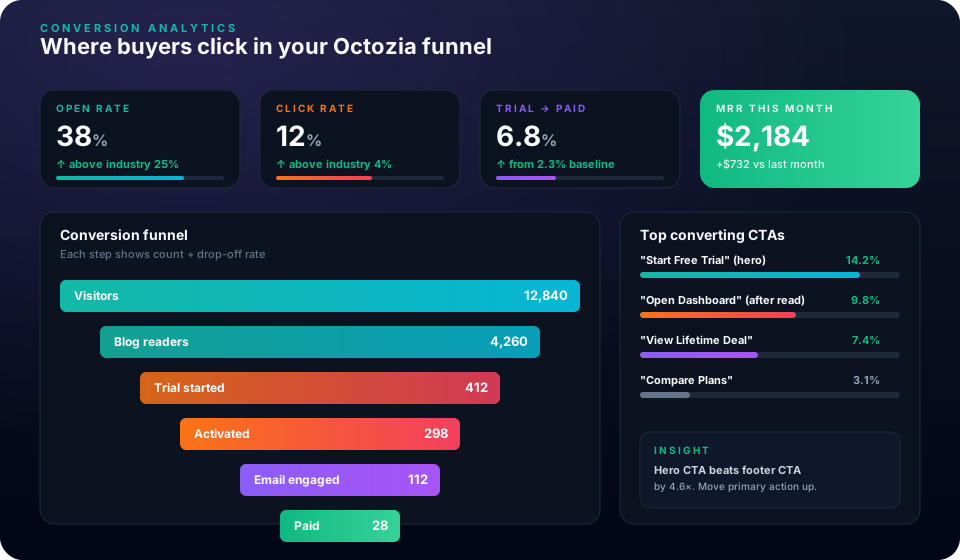
The planner is here to make the workload visible. If micro-niche hunters multiply designs by products, metadata fields, and review checks, niche validation before design production quickly becomes a systems problem rather than a motivation problem. Page focus: POD evergreen market research; first test: test a narrow buyer angle.
Use the sliders to estimate how phrase list and print-on-demand listing workflows turn into repeated actions before Octozia is introduced. Page focus: POD evergreen market research; first test: test a narrow buyer angle.
A good first test for POD evergreen market research should be small enough to trust. Start with test a narrow buyer angle, then keep the result as a reusable note for the next POD marketplaces batch. Page focus: POD evergreen market research; first test: test a narrow buyer angle.
Cycle through test ideas that connect POD evergreen market research to a specific Octozia action. Page focus: POD evergreen market research; first test: test a narrow buyer angle.
Before publishing this page, verify that the title, examples, and CTA all point to niche validation before design production. The dropdowns below keep the article focused on print-on-demand listing workflows instead of drifting into repeated POD advice. Page focus: POD evergreen market research; first test: test a narrow buyer angle.
The page should answer why someone searches for POD evergreen market research and how that maps to print-on-demand listing workflows on POD marketplaces.
The POD evergreen market research article must connect crowded markets to Niche Research Tool without hiding Octozia until the end.
The reader should see a small move such as test a narrow buyer angle for POD evergreen market research, not a vague promise about productivity.
Buttons for POD evergreen market research should appear after the hero, workflow, and planner so micro-niche hunters can test Octozia after seeing the workload.
Use POD evergreen market research naturally, then support it with examples around phrase list, faster batch review, and niche validation before design production.
Use Octozia to turn POD evergreen market research into a cleaner workflow: prepare the batch, reduce crowded markets, create faster batch review, and test the result before scaling. Page focus: POD evergreen market research; first test: test a narrow buyer angle.
For POD evergreen market research, this page is built for micro-niche hunters working on POD marketplaces who need help with niche validation before design production around print-on-demand listing workflows. It should skip generic POD basics and move into the real decision the seller faces while writing metadata.
For POD evergreen market research, Octozia connects the query to Niche Research Tool, then gives the seller a way to organize the phrase list, reduce crowded markets, and measure faster batch review from a small test batch.
For POD evergreen market research, yes, because the searcher has a concrete software-shaped problem. The page should prove the pain with a planner, show test a narrow buyer angle, and place the trial CTA where the next action feels natural.
For POD evergreen market research, specific is better. The page should stay close to print-on-demand listing workflows, POD marketplaces, and niche validation before design production so it does not compete with broader Octozia articles.
For POD evergreen market research, avoid recycled paragraphs, unsupported ranking claims, and generic definitions. The article should use phrase list, crowded markets, and test a narrow buyer angle as its own unique operating example.
For POD evergreen market research, use a trial CTA after the workflow and again after the planner. The reader should feel invited to test faster batch review through test a narrow buyer angle, not pressured by a vague promise.
Octozia bundles the bulk uploaders, niche research, tag generators, trademark checks and KDP generators into one dashboard. Explore all Octozia tools, see how the KDP generators connect to the POD workflow, or jump straight to pricing.
